
INTENT
INtelligent use of ec for waTEr managemeNT. A low-cost probe system that uses electrical conductivity as a proxy for discharge and dissolved major ions. ERDF / REACT-EU project 2022–2023, consortium of TerraTransfer, Bochumer Institut für Technologie (BO-I-T) and Okeanos Smart Data Solutions. INTENT is the direct ancestor of the Aquatos Web LTX product line.
INTENT
An energy-autonomous IoT probe with hybrid uplink — and a new approach that uses electrical conductivity as a low-cost proxy for major ions and discharge.
INTENT was an application-oriented R&D project with two strands. First, the development of a new generation of measurement probes for surface and groundwater: compact, energy-autonomous and capable of carrying multiple sensors on a single rugged bus. Second, a scientifically supported method that derives time series of dissolved major ions and a proxy for discharge from continuous electrical-conductivity (EC) measurements. The goal was to enable broad-coverage water monitoring in the sense of the EU Water Framework Directive without operating a separate expensive sensor for every parameter.
Beyond TerraTransfer, the consortium included the Bochumer Institut für Technologie (BO-I-T) and Okeanos Smart Data Solutions GmbH. Associated partners were the Erftverband with nine measurement sites in its catchment, as well as the TH Köln and the Technical University of Munich (TUM) as scientific partners. INTENT is the direct ancestor of today's Aquatos Web LTX: many design choices — from form factor to power management to connectivity — were validated in INTENT and then carried forward into the series product.
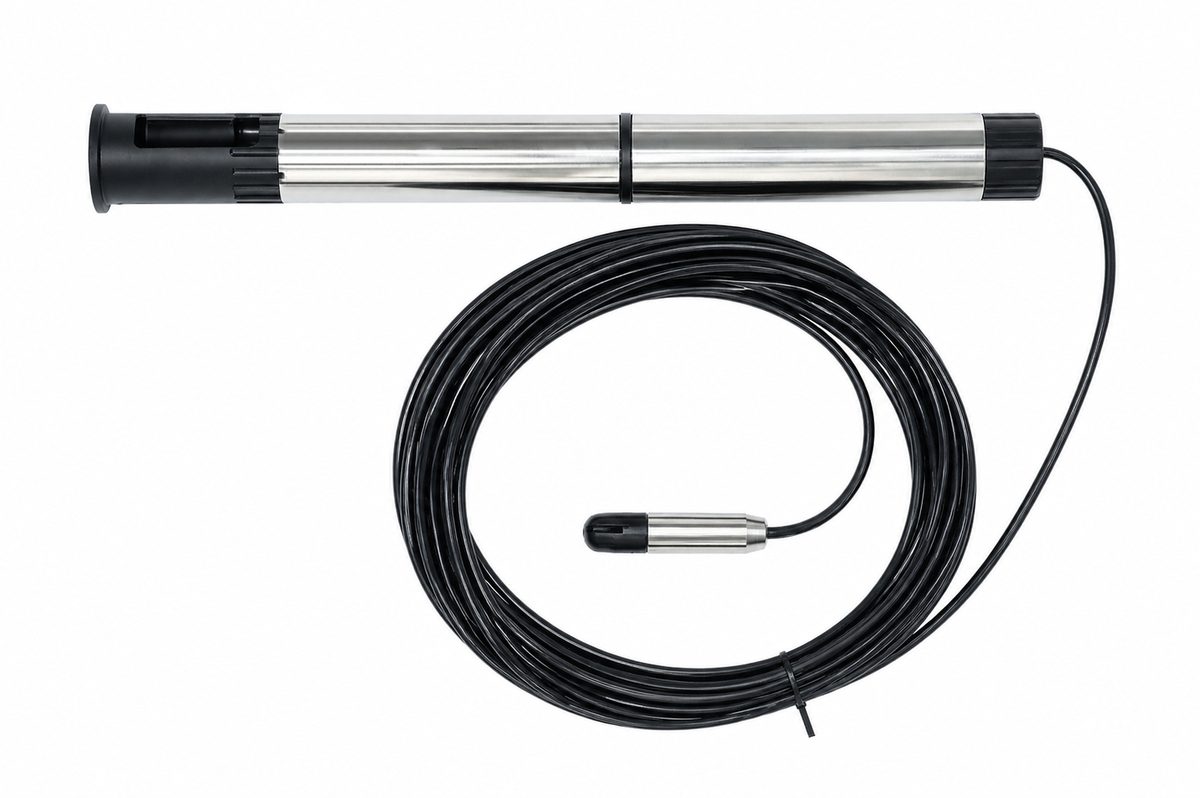
Aquatos Web LTX, the series probe born out of INTENT.
Consortium partners
- TerraTransfer GmbH Hardware and platform development, probe design, build-out and operation of the reference measurement network
- Bochumer Institut für Technologie (BO-I-T) Concept and data analysis, development of the EC-based evaluation methodology
- Okeanos Smart Data Solutions GmbH Data platform and smart-data processing
Associated partners
- Erftverband Nine measurement sites in the Erft catchment, weekly water sampling and laboratory analysis
- TH Köln (Cologne University of Applied Sciences) Scientific support for the EC methodology
- Technical University of Munich (TUM) Scientific support and modelling
Technical building blocks
- Slim, rugged probe form factor for gauge tubes, manholes and standpipes
- Cellular uplink via LTE-M with NB-IoT fallback (Quectel BG600L-M3)
- Optional satellite uplink (SWARM) for sites without cellular coverage
- Multiple physical sensors on an SDI-12 bus, pressure sensor integrated
- Energy-autonomous through solar panel and long-life primary battery options
- Bluetooth Low Energy for on-site commissioning and diagnostics
- Integration with the TerraTransfer data platform for live visualisation and alerting
Outcomes and transfer to series production
The assemblies validated in the project went into the series product Aquatos Web LTX. The factory-test and delivery figures since Q4 2024 show that the architecture (LTE-M + NB-IoT fallback, SDI-12 bus, solar and battery, BLE service interface) scales in practice. The same architecture underpins the more compact variants Aquatos mini and Aquatos nano.

Funded by the European Union (REACT-EU) and the State of North Rhine-Westphalia under the ERDF programme NRW, reference number RU-1-1-037A.
Interested in a research partnership?
We bring measurement hardware, platform development and experience with public agencies. Get in touch if you are planning a consortium project — federal, EU or regional.